
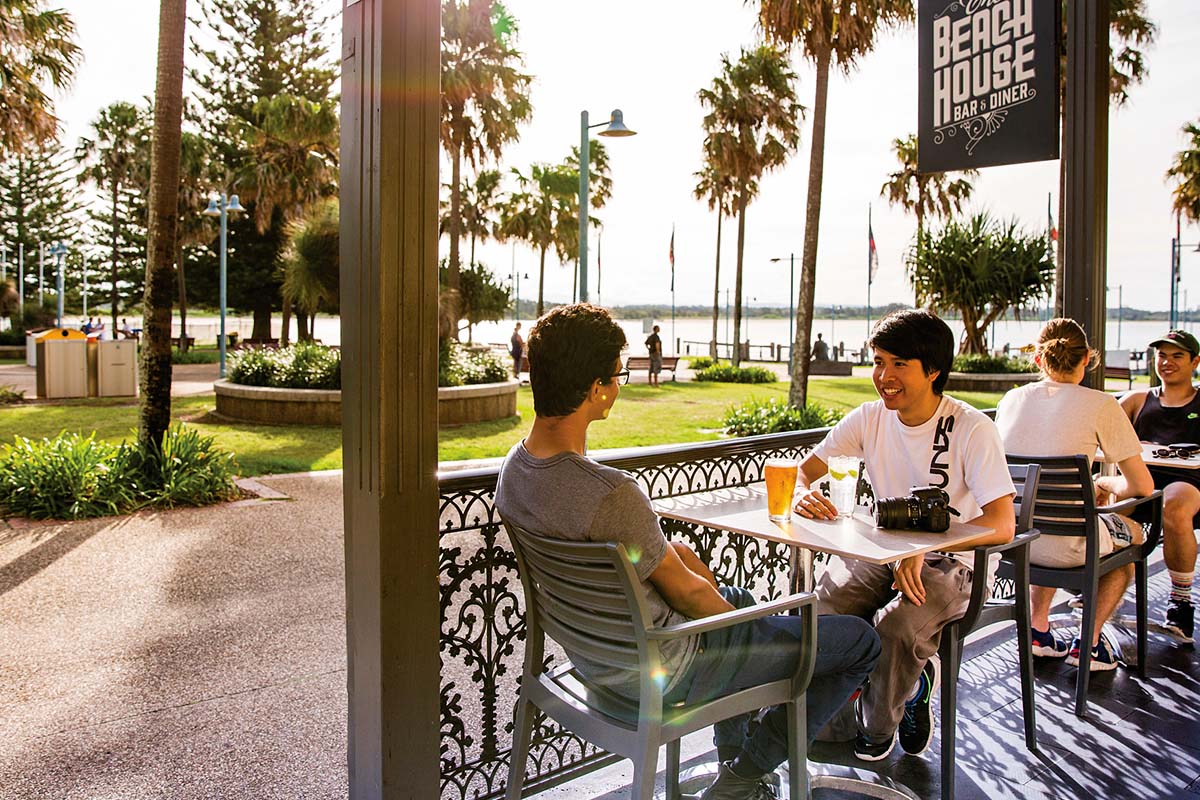
NSW has the perfect climate for outdoor dining, bringing life to our streets and public spaces. Outdoor dining gives people a way to reconnect and socialise.
The NSW Government's vibrancy reforms have permanently relaxed the rules for outdoor dining, allowing venues to make the most of their outdoor space with a quicker, simpler process.
Businesses that meet the exempt criteria under the State Environmental Planning Policy (Exempt and Complying Development Codes) 2008 (Codes SEPP) can offer outdoor dining as exempt development on:
- the footpath or public open space, subject to a permit issued by the local council
- on private land with the landowner's permission
- at registered clubs.
We’ve also introduced changes to the number of patrons certain venues can accommodate via the Cultural SEPP. If a venue meets the required development standards, it may be able to increase total patron capacity without needing to modify the maximum patron capacity stated in an existing development consent.
Patron capacity increases vary depending on current approved capacity:
- If a venue is approved for up to 100 patrons, capacity can be increased by up to 20%.
- If a venue is approved for more than 100 patrons, capacity can be increased by up to 15%, with a maximum of 50 additional patrons.
- If a venue is in a Special Entertainment Precinct, capacity may be able to increase by up to 30%, with a maximum of 100 additional patrons.
These increases are only allowed if your venue complies with all relevant development standards in the Codes SEPP and some venue types are excluded. Venues cannot reduce required car parking to make room for more patrons.
The provisions do not override patron limits set by other approvals or regulatory requirements, such as a liquor license, or building code and fire safety requirements. Venue operators are responsible for ensuring compliance with all applicable approvals and requirements.
How do businesses apply?
Venue owners must obtain the landowner’s consent to use the land for outdoor dining. This can include land such as bowling greens or car parks but cannot include roof tops. Read Outdoor Dining (PDF, 780 KB) to see if your proposed area meets the exempt development standards.
Footpaths and roads
The State Environmental Planning Policy (Exempt and Complying Development Codes) 2008 (Codes SEPP) allows food and drink premises such as cafes, restaurants, pubs, and small bars across the state to have outdoor dining on the footpath as exempt development.
This means hospitality businesses can apply to council to use the footpath and public spaces to serve diners outside without needing a separate development application. Instead, councils issue permits approved under the Local Government Act or Roads Act.
Visit NSW legislation for more information about outdoor dining on footpaths and roads. If you are unsure if council approval is needed for the use of the land, contact your local council.
Registered clubs
Registered clubs’ food and drink premises can set up outdoor dining areas without a development application using an exempt development pathway.
Venue owners must obtain the landowner’s permission and meet the development standards. Clubs on community land should contact their local council.
Use of Crown land as an outdoor dining area may still require additional approvals or variation to your existing tenures under the Crown Land Management Act 2016.
Visit NSW legislation for more information about outdoor dining at registered clubs. For more information about the Crown land requirements, contact your Crown land manager or visit Crown Lands.
Liquor licence
If you want to operate your food service business outdoors, the boundary of your liquor licence must include the outdoor dining area. Venues must comply with their usual liquor licence conditions in the outdoor dining area.
See Liquor and Gaming NSW's Outdoor dining change of boundaries for more information on how to change your liquor licence for outdoor dining or contact the Hospitality Concierge.
More information
For more information on changes made via the Cultural SEPP, go to Night-time economy or the NSW Planning Portal.
See the Codes SEPP for more details on the development standards that apply to private land and registered clubs.