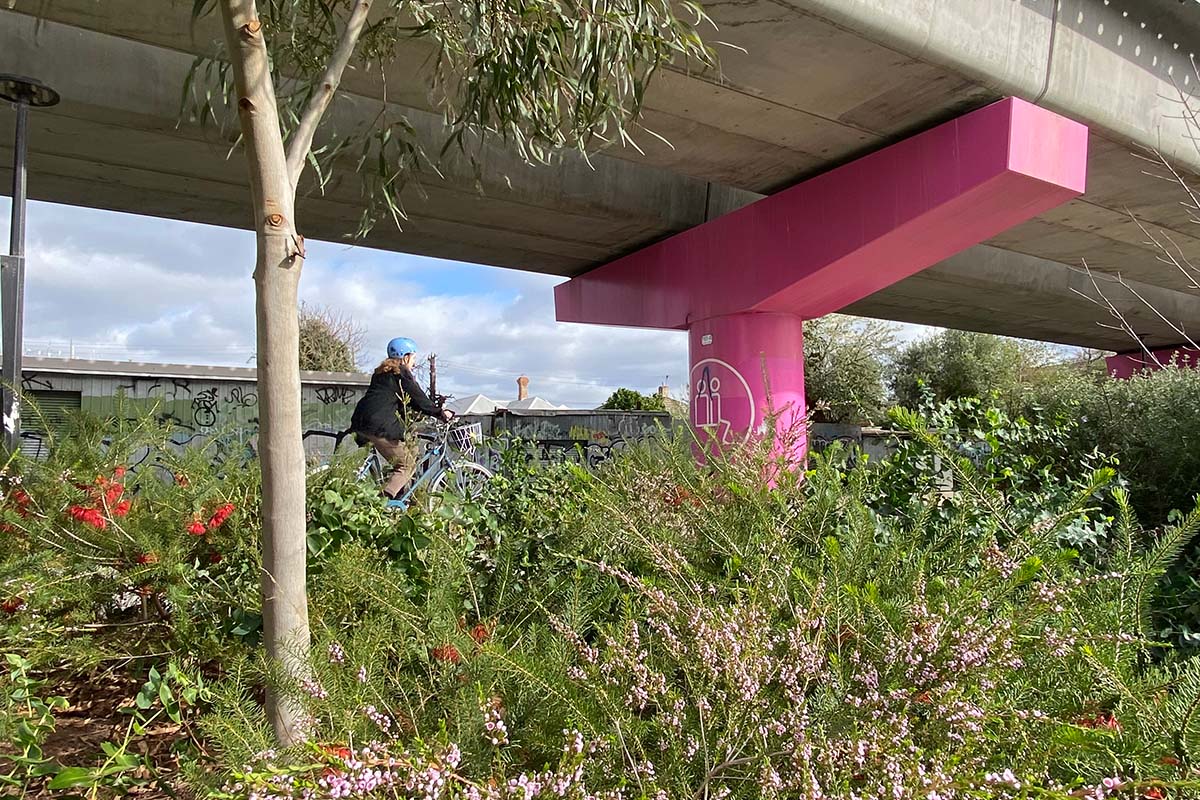
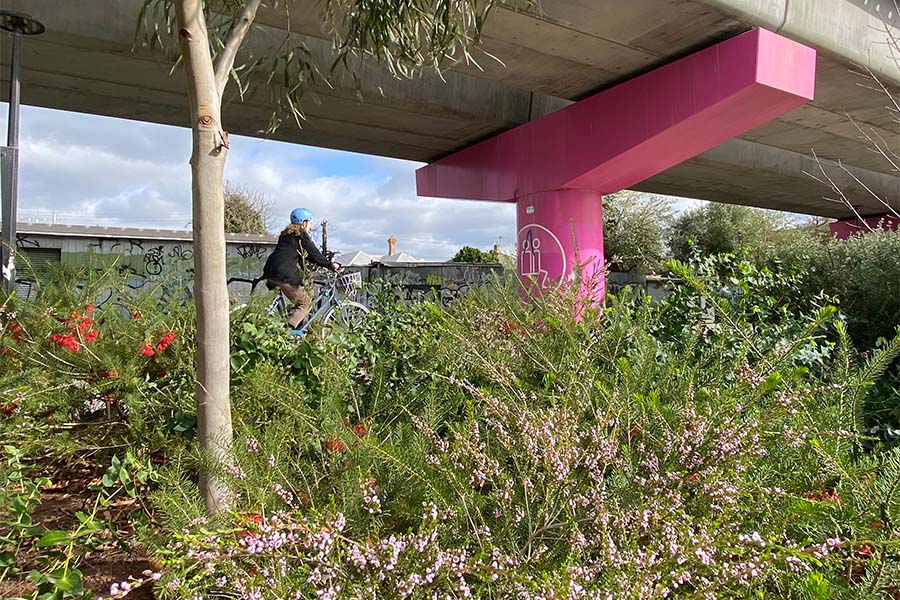
Through research, extensive engagement and collaboration, woody meadows are rapidly changing Australian cities. They use natural Australian shrublands as templates to create beautiful, diverse plantings of woody shrubs and small trees and are maintained through coppicing or hard pruning every 2–4 years.
Developed by the University of Melbourne and research partners, woody meadows offer a flexible urban greening solution for a range of contexts, sites and design objectives. The flexibility and adaptability of woody meadows have been demonstrated by plantings along roadsides and train lines, around train stations, in traffic roundabouts, parks and residential street verges and as part of water-sensitive urban designs. Woody meadows can also be designed as low plantings under new or existing canopy trees, helping improve biodiversity in streetscapes.
Woody meadows are growing exponentially with over 15,000 m2 installed in the last 12 months – total plantings 30,000 m2, worth $3.3 million across 50 locations – in partnership with councils, state government agencies and community groups. Woody meadows are part of major infrastructure projects including Melbourne’s Level Crossing Removal Project (LXRP), Sydney Metro Rail project, and East Subiaco redevelopment (Perth).
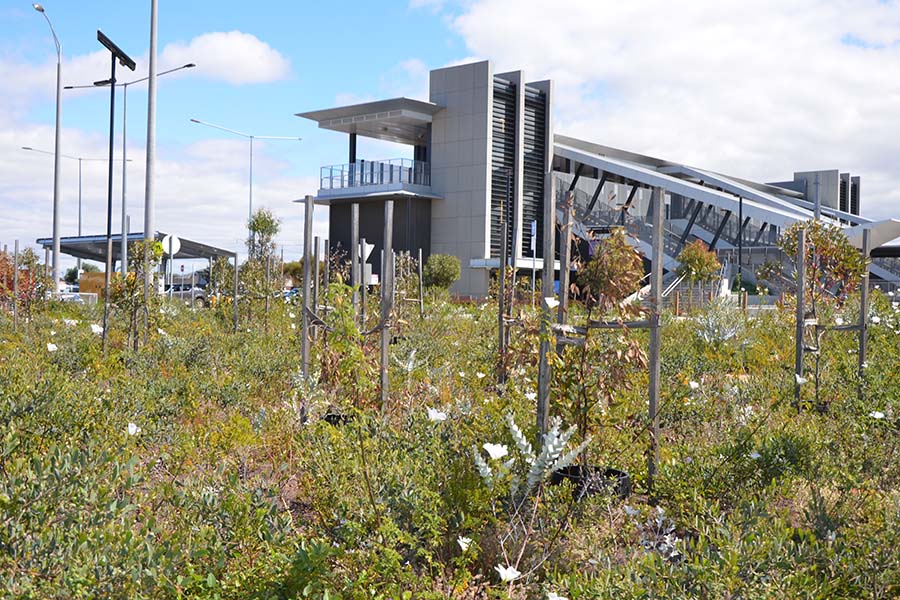
Trial in St Ives Chase
The Ku-ring-gai Council Woody Meadow trial at Transmission Park St Ives Chase demonstrates a cost-effective approach to deliver urban greening solutions. The project is robust and multifunctional, increasing urban biodiversity, improving air quality, providing urban cooling and improving surface water management. The trial has resulted in the planting of more than 16 Indigenous species and upwards of 400 plants to create a visually appealing, highly diverse and low-maintenance landscape. With the high numbers of flowers, the diverse layered planting encourages insects, native bees, small birds and other wildlife.
Lessons and collaboration
Woody meadows are visually appealing and can reduce weed growth and maintenance costs for public land. Site preparation to remove weeds and remediate from compaction is fundamental to the success of the project. Pre-treatment and eradication of weeds should be based on an assessment of the weed flora present. Repeated herbicide applications with a long lead-time prior to planting have proven to be highly effective in reducing weed competition after planting.
The Ku-ring-gai Woody Meadow has a locally Indigenous plant palette growing in a crushed sandstone substrate. Council looked at 2 site preparation approaches and found plants growing in a crushed sandstone substrate survived and grew better than those in existing substrate covered with jute matting – the council’s standard approach for weed control at newly planted sites.
A typical proportion of plants for each layer in a woody meadow trial is roughly 70% low growing shrubs in the base layer, 25% in the mid-layer (shrubs that grow from 1 to 1.5 m tall) and 5% in the upper layer (shrubs and small trees between 2 and 3 metres high). The layering is intended to mimic the natural form of the community from which the plants are drawn and to maintain year-round visual interest.
Maintenance by council staff and local volunteers is key to the continued success of the planting.